
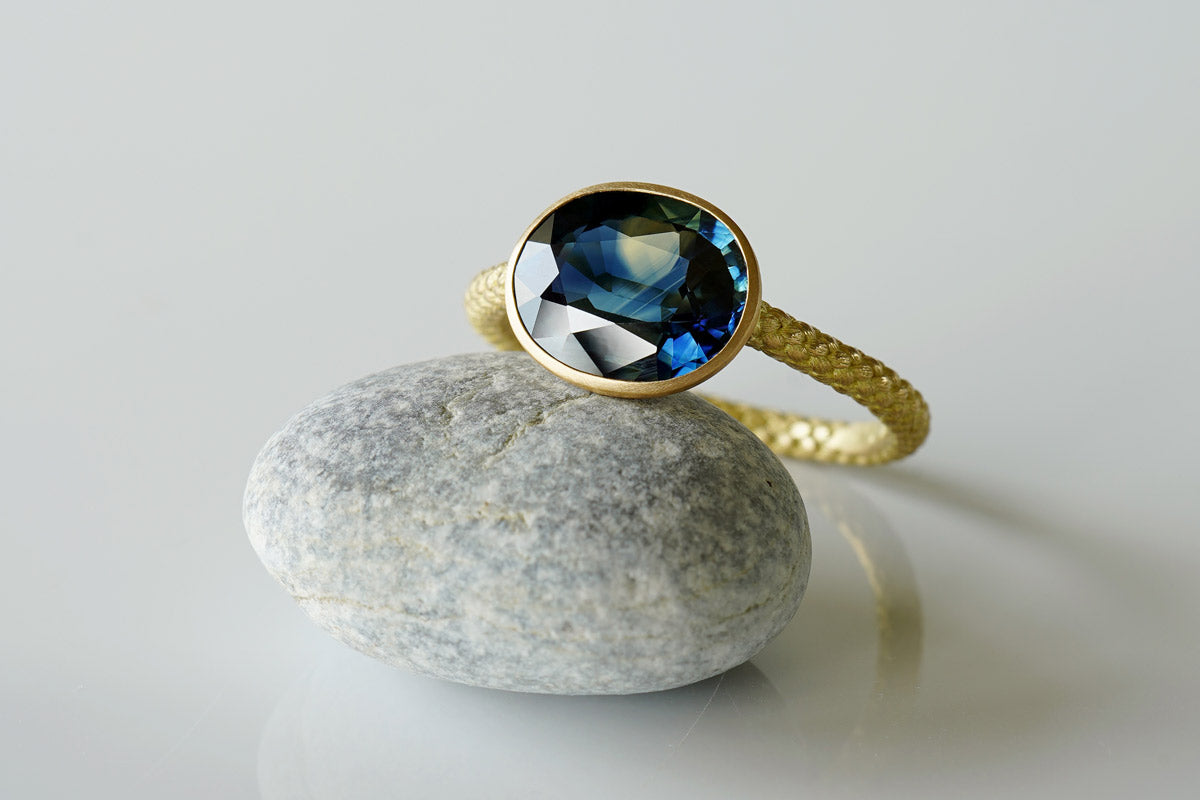
Sapphire
Multi-colored sapphires in a wide variety of hues.
Derived from the Latin word "sapphirus" meaning blue, its Japanese name is "seigyoku" (blue jewel).
In medieval Europe, it was known as the "gem of the heavens."
Ancient people believed that the earth we live on rested atop a giant sapphire and that the blue of the sky was a reflection of that color; thus, it has long been cherished as a stone that connects the earth and the sky.
At talkative, we craft jewelry with sapphires in a diverse range of colors, centering on teal sapphires, Montana sapphires, and padparadscha sapphires, as well as classic blue sapphires and nuanced stones with bi-colors and gradients.
Among these, party-colored teal sapphires—"teal" meaning the color of a duck's wing, where two colors blend together—are among the designer's favorite stones to work with.
Those from Australia, where blue and green are clearly divided into bands, are also called "party-colored teal sapphires" and are characterized by their high saturation. On the other hand, Montana sapphires often feature a calm teal where the colors melt together smoothly, meaning even "teal" stones have different expressions depending on their origin.
The names of the towns in Australia's sapphire mining district are also intriguing; towns named "Sapphire," "Rubyvale," and "Emerald" sit side by side, yet only sapphires are actually mined in these three towns named after gemstones.
It is said that the town of Emerald was named for the green of the pastures, but local lore suggests it may have been because green sapphires found in the area were mistaken for emeralds.
They say that charming signs featuring the names of the gems greet visitors at the entrance to these towns.
"Sapphire" is a mineral known as corundum that is mined all over the world.
However, for a crystal to develop with both clarity and color, limited conditions involving specific temperatures, pressures, and trace elements must be met, which creates the rarity of the sapphire.
It also possesses a hardness of 9, second only to diamond, which is why it is chosen not only for fashion but also for engagement rings intended to last a lifetime.
While being the same stone, there are as many stories as there are places where it was born—that is the endless charm of this gem.
The birthstone for September.